Welcome to the Mineral Field Notebook User's Guide from Reinomineral.site.
I am going to explain to you step by step how I have completed the example page that you will find in the notebook. This is one way to do it, but… imagination to power. You can use this notebook with your own way to do it. The important thing is that it is useful for your mineral search outings.
And first of all I would like to tell you that the referred example is a real example. That is, you can use the coordinates that I indicate in the file and you will be able to find yourself the mineral to which it refers. In this case pistomesite (a variety of magnesite found in some localities in the province of Alicante in Spain).
The process of completing each file is very intuitive. You just have to fill in each box with the name of the specimen you think you have found. and I say that you think you have found it because, as it is a field notebook, you should not consider getting all the data you have to fill in right the first time. You should leave that for later analysis at home. That is why I advise you to make notes in pencil during fieldwork so that it is easy for you to make the necessary corrections later.
Let's go to the task.
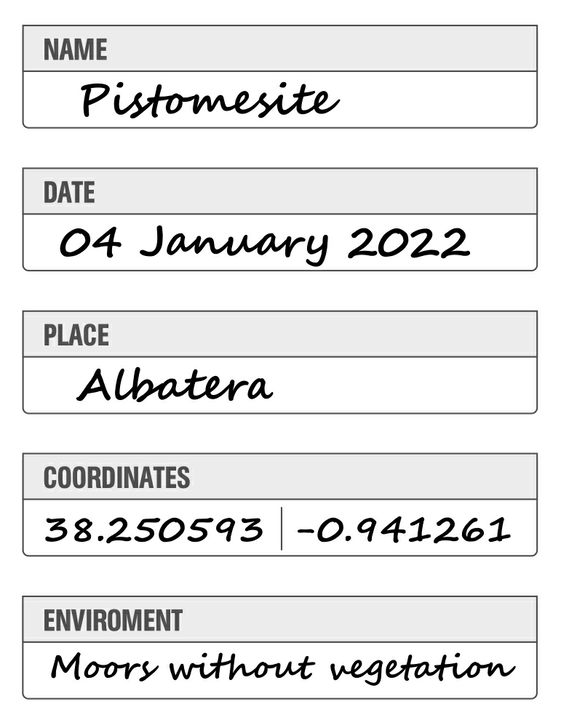
- NAME: You must indicate the name of the mineral found.
- DATE: Date of discovery
- PLACE: Town where the specimen was found
- COORDINATES: Today and thanks to technology we can accurately geolocate the exact place where we made the discovery of specimens. This is important to be able to return on a new search expedition or to pass on the information to a colleague who also wishes to investigate the place.
- ENVIRONMENT: As a complement to the above, it is advisable to describe with a word the environment where the discovery has been made. Roughly we could define them as:
- Paramo
- Desert
- Forest
- Marine
- River
- Etc.
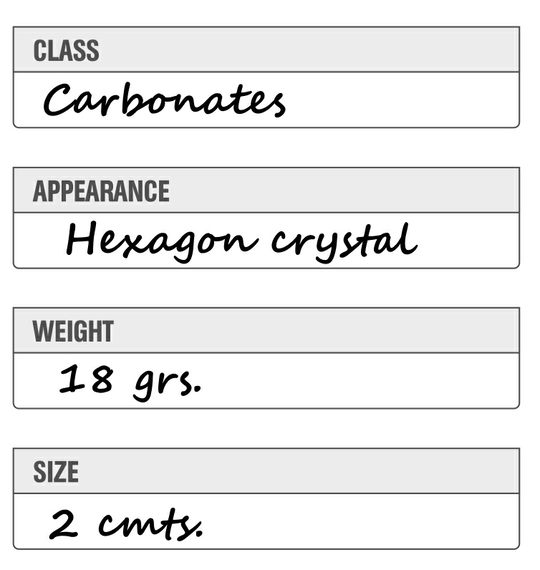
- CLASS: Indicates to which class the finding belongs. My advice is to use the new Strunz classification to classify your collection.
- ASPECT: What does the mineral look like? Is it a crystal? An amorphous mass to the naked eye? Earthy? Fibrous?.
- WEIGHT: If you do not have a small portable weight, you must fill in this information once you carry out a more complete analysis at home.
- SIZE: indicates the size of the specimen. It is good to carry a small ruler or a “keychain type” meter with you on your outings.
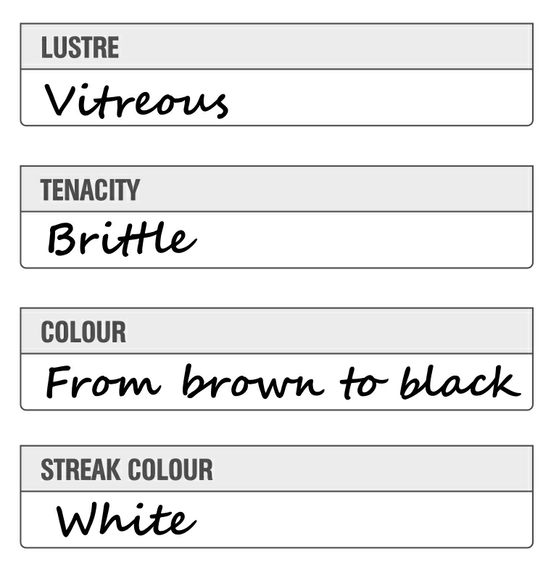
- LUSTRE: Here you should indicate the type of shine that the mineral has: vitreous, adamantine, metallic, fatty, etc.
- TENACITY: Can it be broken or bent? Toughness can be: Brittle, Sectile, Malleable, Ductile, Fexible, Elastic.
- COLOUR: A characteristic that is seen with the naked eye. Indicate it here.
- STREAK COLOUR: It would be interesting if you took a small ceramic plate with you. Rub the specimen over it and note what color the resulting streak is.
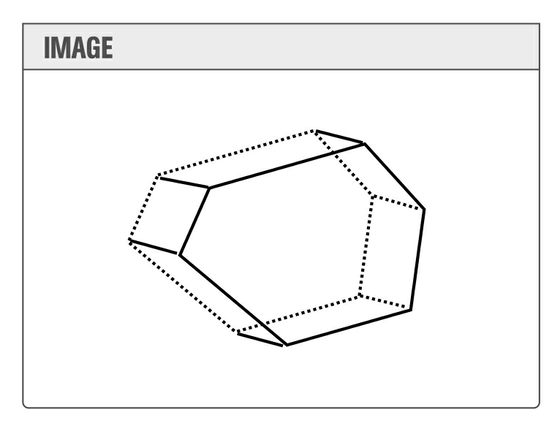
- PICTURE: Here counts the skill of each one to make a sketch of the specimen found. Personally, as I am lousy at drawing, I have made a schematic drawing of a hexagonal crystal of pistomesite.
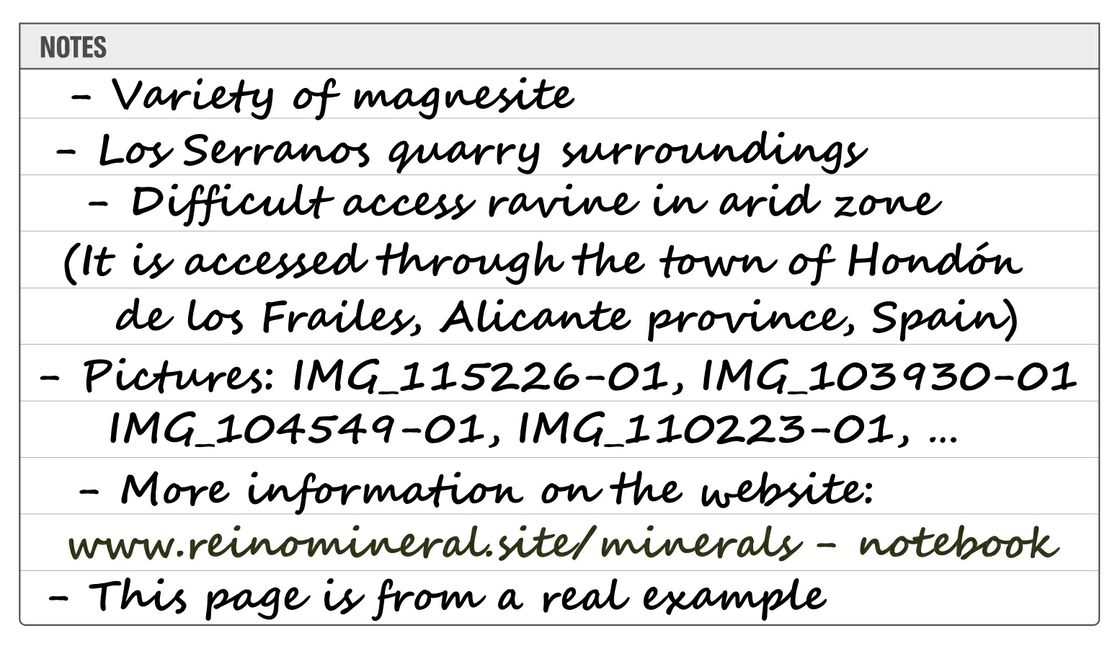
- NOTES: I have included ample space for notes because I think it is important to reflect issues related to the search for minerals that are not properly characteristic of it. These can be:
- Permissions to request to be able to search in a certain place.
- Accessibility
- List of photographs that we must take of the place, the environment, the access, the specimens, etc.
- Bibliographic references
- References of web pages that help us to identify the mineral or the environment.
- etc.
And that's all.
I hope this guide has been helpful to you in getting the most out of your mineral field notebook.
This is a wonderful hobby that will allow you to be in continuous contact with nature, enjoy spectacular surroundings and good company.
All of us who are dedicated to collecting minerals feel that more than a hobby it is a privilege to be able to enjoy it.
So, whether you are already an experienced collector or if you are taking your first steps in the world of minerals, use this notebook to keep your outings in search of new specimens in order.
I can only thank you for purchasing my mineral field notebook and remind you that you also have two more field notebooks available on Amazon: one for fossils and one for rocks.
I hope we meet at a field trip.
All the best.